A study by Scripps Institute researchers predicts that even under conservative climate change scenarios, the Colorado River will not be able to supply water to meet the current demands 60 to 90% of the time by the year 2050. Researchers also predicted that the reduction in the runoff feeding the river will mean shortages of 400,000 acre feet of Colorado River water 40% of the time by 2025.

“People have talked for at least 30 years about the Colorado being oversubscribed but no one ever put a date on it or an amount. That’s what we’ve done. Without numbers like this, it’s pretty hard for resource managers to know what to do.” – Barnett
Millions of acres of farmland and tens of millions of people depend on water from the Colorado River system, and if human-caused climate change continues to increase drought severity, shortages would be a huge blow to the western United States. Most shortfalls could be covered through water transfers and conservation efforts, but during dry years, the chance of substantial shortages is greatly increased.
“Fortunately, we can avoid such big shortfalls if the river’s users agree on a way to reduce their average water use. If we could do that, the system could stay sustainable further into the future than we estimate currently, even if the climate changes.” – David Pierce, climate researcher
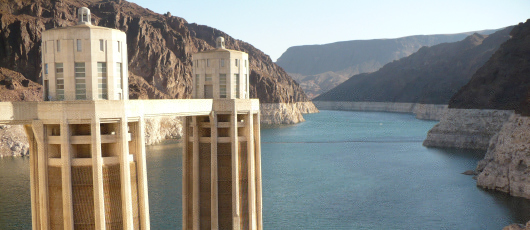
The same researchers, Tim Barnett and David Pierce, published a study in 2008 which found that Lake Mead had a 50% chance of going dry in the next 20 years if no effort was made to preserve a minimum amount of water in the reservoir and the climate continued to changed. The authors’ most recent study looks at the cuts required in water delivery while maintaining water levels in the reservoir to continue the supply to Las Vegas.
The researchers make a point of saying that Lake Powell and Lake Mead were built during and calibrated to the 20th century, one of the wettest in the last 1,200 years. Analysis of tree ring records show that Colorado River flows in typical years are substantially lower, yet most long-term planning regarding the river uses those same 20th century water values. If the river’s flow is more in line with that shown by the tree rings, the Colorado River water shortfall could be even more severe.
“All water-use planning is based on the idea that the next 100 years will be like the last 100. We considered the question: Can the river deliver water at the levels currently scheduled if the climate changes as we expect it to. The answer is no.” – Scripps research marine physicist Tim Barnett
The research paper, “Sustainable water deliveries from the Colorado River in a changing climate,” is published in the April 20 edition of the Proceedings of the National Academy of Sciences.
You must be logged in to post a comment.