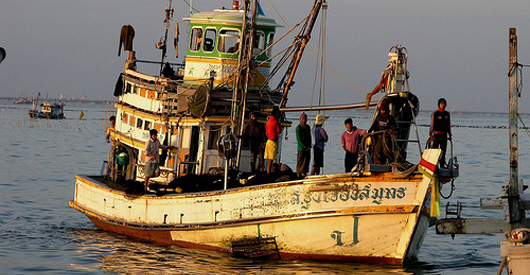
It’s hard to imagine slavery still exists in the twenty-first century, but human trafficking is a modern problem called the “fastest-growing criminal industry in the world”. For example, the fishing industry in Thailand is supported by slaves, mostly Burmese migrants. Some of this slave-based catch ends up in US markets.

Of course, no one enters willingly into slavery. In Thailand, brokers coax Burmese workers by promising jobs. As described in The Global Post, migrants pay $350 to be smuggled into the country, where they are hired on fishing vessels. Unfortunately, these Burmese fisherman never receive pay, cannot quit, and may face murder.
Americans almost certainly eat fish that was caught by forced labor in Thailand. The Global Post reports:
Thailand is the world’s largest seafood exporter and the United States is its largest buyer. One third of America’s shrimp is imported from Thailand, home to a $2-billion shrimp industry and a major supplier of tuna, squid and other frozen seafood imports. But it’s an open secret that the industry relies, in part, on forced labor…The supply chain eventually leads to America’s largest supermarkets, according to investigations by the Solidarity Center, a non-profit agency under the AFL-CIO.
The Global Post identifies “Costco, Giant, Harris Teeter, Trader Joe’s and Walmart” as retailers who sell slavery seafood from Thailand. Trader Joe’s has already been called “Traitor Joe’s” by Greenpeace for selling red listed seafood, but seafood slavery makes this popular retailer even more worthy of boycotting.
Thailand is well known for its child slavery, with children often being forced into prostitution. Between 60,000 to 200,000 children are sold into brothels, and virginity sells for $3500 in Bangkok, according to Time. Most Americans are abhorred by such statistics, but do they realize their Trader Joe’s shrimp is a result of human trafficking as well?
Unfortunately, the Thai government has not been successful at cracking down on seafood slavery. Doling out fines of only $2,100 and allowing shrimp factories to continue operating after being busted for forced labor of children has been ineffective. Monitoring conditions on fishing vessels is even more difficult than in factories. “Forced labor remains endemic in the seafood industry” in Thailand with estimates of 200,000 Burmese migrants working in the industry.
You must be logged in to post a comment.